
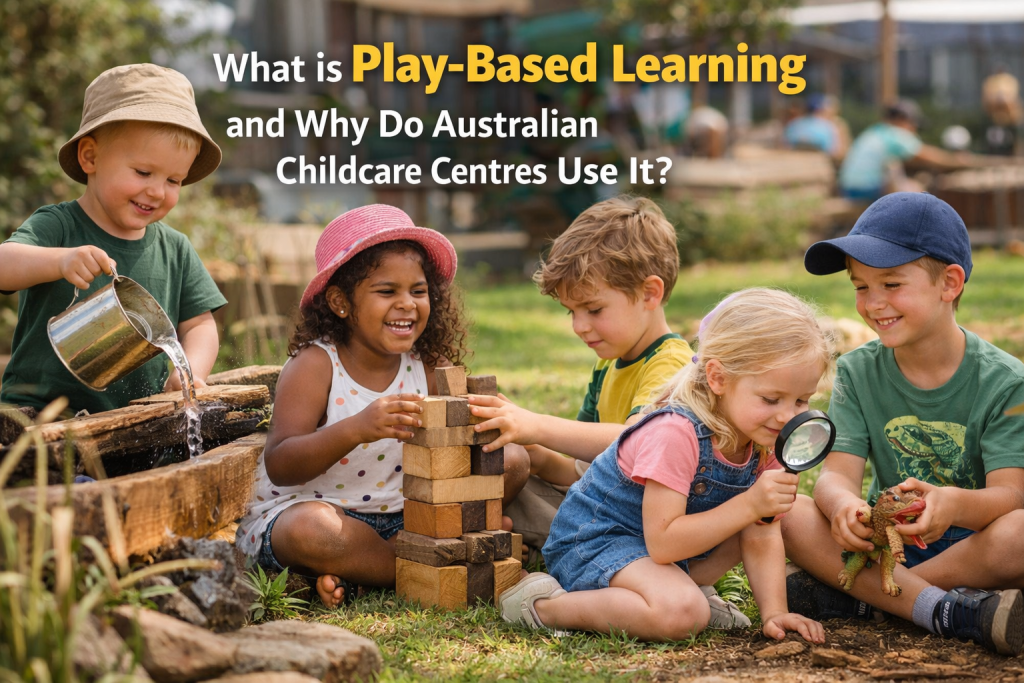
Walk into any quality early learning centre and you will likely see children building towers, splashing in water trays, role-playing in a pretend kitchen, or creating artwork with their hands. To an untrained eye, it might simply look like fun. To an early childhood educator, it is something far more deliberate — it is play-based learning in action.
Play-based learning is one of the most researched, widely endorsed, and deeply effective approaches to early childhood education in the world. It sits at the heart of how quality Australian childcare centres operate, and for very good reason. Understanding what it is — and why it works — helps parents appreciate the genuine educational value happening every single day their child spends at a childcare centre in Prestons or anywhere across the country.
What is Play-Based Learning?
Play-based learning is an educational approach where play is used as the primary vehicle through which young children explore, discover, and make sense of the world around them. Rather than sitting at desks and completing worksheets, children learn through hands-on experiences, imagination, social interaction, and self-directed exploration.
It is important to understand that play-based learning is not simply free play with no purpose. There are two distinct forms:
Free play — child-initiated, unstructured exploration where children choose their own activities and follow their own curiosity. This builds creativity, decision-making, and independence.
Guided play — intentionally designed by educators to introduce specific learning goals, while still allowing the child to lead the experience. An educator might set up a counting activity using natural materials, then step back and observe while gently extending the child’s thinking with questions.
Both forms are valuable. Together they create a rich early learning environment where children are active participants in their own development rather than passive recipients of instruction.
The Science Behind Why Play Works
The evidence supporting play-based learning in early childhood is substantial. Neuroscience research confirms that the early years — from birth to age 5 — represent the most rapid period of brain development in a human lifetime. During this window, children form neural connections at a rate that will never be repeated.
Play is the mechanism through which those connections are built. When a toddler stacks blocks and they fall, they are learning cause and effect. When a group of preschoolers negotiate roles in a pretend game, they are developing language skills, emotional regulation, and social understanding simultaneously. When a child mixes colours at a painting table, they are experimenting with science concepts, building fine motor skills, and expressing creativity all at once.
Play activates multiple areas of the brain at the same time — something direct instruction alone cannot replicate in young children. It is multisensory, emotionally engaging, and intrinsically motivating, which means children learn more deeply and retain what they discover far longer.
Play-Based Learning and the Australian Early Years Learning Framework
In Australia, play-based learning is not simply a philosophical preference — it is embedded in national policy. The Early Years Learning Framework (EYLF), titled Belonging, Being and Becoming, is the official curriculum framework guiding all approved early childhood education and care services across the country.
The EYLF explicitly recognises play as the foundation of early learning. It identifies five key learning outcomes for children:
- A strong sense of identity
- Connection with and contribution to the world
- A strong sense of wellbeing
- Confidence and involvement as learners
- Effective communication skills
Every one of these outcomes is developed most powerfully through play-based experiences. Educators at quality childcare centres across Australia — including here at Wiggles and Giggles Prestons — use the EYLF to plan, observe, and document how each child is progressing through meaningful play experiences tailored to their individual interests and developmental stage.
What Do Children Actually Learn Through Play?
This is the question most parents want answered — and the answer is more comprehensive than many expect.
Cognitive Development
Through play, children develop problem-solving skills, logical thinking, mathematical concepts, and early literacy understanding. Building with blocks introduces geometry and spatial reasoning. Dramatic play builds narrative thinking and vocabulary. Science exploration develops observation and hypothesis skills.
Language and Communication
Play is one of the richest environments for language development in early childhood. Children narrate their actions, negotiate with peers, listen and respond, ask questions, and build vocabulary organically through context — far more effectively than through rote learning.
Social and Emotional Skills
Cooperative play teaches children to share, take turns, manage disagreements, read social cues, and develop empathy. These social-emotional learning skills are among the strongest predictors of long-term wellbeing, academic success, and healthy relationships.
Creativity and Imagination
Open-ended play gives children permission to think divergently — to imagine, invent, and create without fear of being wrong. This creativity is not just an artistic skill; it underpins innovation, adaptability, and resilience throughout life.
Physical Development
Active play develops gross motor skills — running, climbing, balancing, and jumping — while activities like drawing, threading, and clay modelling build the fine motor skills children need for writing and self-care tasks.
Independence and Confidence
When children make choices in play — deciding what to build, how to organise a game, what comes next in their story — they develop self-regulation, confidence in their own ideas, and a sense of agency that carries directly into school readiness.
Why Australian Childcare Centres Choose Play-Based Learning
Quality early learning centres in Australia adopt play-based approaches because the research is unambiguous — it produces better developmental outcomes than formal, academic-style instruction for children under six.
Young children are not neurologically ready for the kind of abstract, sit-down learning that works for older students. Their brains are wired to learn through movement, experience, emotion, and social connection. Forcing structured academic tasks too early can actually undermine a child’s natural motivation to learn. It create anxiety and disengagement rather than capability.
Play-based learning works with a child’s developmental biology, not against it. It produces children who are genuinely curious, emotionally confident, socially capable, and academically prepared — not because they were drilled with facts, but because they were given the freedom to discover, explore, and think.
At Wiggles and Giggles Prestons, educators design every learning environment and daily experience with this philosophy at its core. Whether children are exploring the outdoor garden, collaborating on a construction project, or engaging in imaginative role play, every experience is purposefully connected to their holistic development and individual learning journey.
What Parents Can Do at Home
Play-based learning does not stop at the childcare gate. Simple activities at home powerfully reinforce what children experience at their early learning centre.
- Read together daily — storytelling builds language, imagination, and emotional intelligence simultaneously
- Offer open-ended materials — cardboard boxes, playdough, water, and natural objects invite creativity far more than battery-operated toys
- Ask open questions — “What do you think would happen if…?” develops critical thinking during everyday play
- Let them be bored — unstructured time gives children the space to initiate their own play, building creativity and self-direction
- Play alongside them — your engaged presence during play is one of the most powerful developmental tools available to any parent
Play is the Work of Childhood
The phrase is often attributed to early childhood pioneer Maria Montessori, and it has never been more relevant. When a child plays, they are not taking a break from learning — they are learning, in the most natural, effective, and joyful way their developing brain knows how.
At Wiggles and Giggles Prestons, play-based learning is not just a teaching method — it is a commitment to giving every child the foundation they need to grow into confident, capable, and curious learners. Because when children are given the freedom to play well, they are being set up to live and learn well.


