
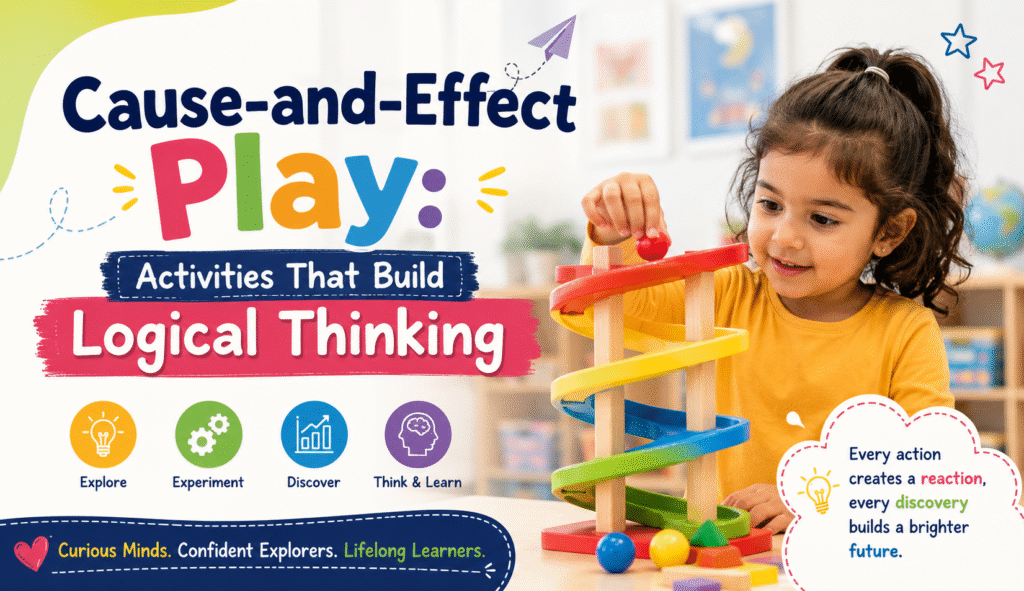
Understanding how actions lead to outcomes is one of the most important skills children develop during their early years. At Wiggles and Giggles, we believe that meaningful play helps children become confident problem-solvers while encouraging curiosity and creativity. A quality Preschool in prestons provides children with opportunities to experiment, observe results, and develop logical thinking through engaging, hands-on activities that make learning enjoyable.
What Is Cause-and-Effect Play?
Cause-and-effect play is a type of learning where children discover that one action creates a specific result. For example, pressing a button may produce a sound, stacking blocks too high may cause them to fall, or pouring water into different containers changes the water level. These simple experiences teach children that every action has a consequence.
This style of learning encourages children to ask questions, make predictions, test ideas, and learn from their experiences. Rather than simply memorising information, they develop an understanding of how the world works through exploration.
Why Logical Thinking Matters in Early Childhood
Logical thinking is the foundation for future academic success and everyday problem-solving. It helps children:
- Recognise patterns
- Make informed decisions
- Solve simple and complex problems
- Improve concentration
- Build confidence through independent learning
- Develop reasoning skills
A nurturing prestons Preschool creates learning environments where children can safely explore these concepts while being guided by experienced educators.
Cause-and-Effect Activities That Build Logical Thinking
Building Block Challenges
Building towers using wooden blocks or construction toys helps children understand balance, stability, and gravity. As children experiment with different shapes and sizes, they quickly discover why some towers remain standing while others collapse.
Each attempt teaches valuable lessons about planning, testing ideas, and adjusting strategies based on previous outcomes.
Water Exploration
Water play naturally introduces children to scientific thinking. They observe how water flows, fills containers, sinks certain objects, and floats others.
Activities may include:
- Pouring water into measuring cups
- Floating and sinking experiments
- Using funnels and pipes
- Filling different-sized containers
Children begin predicting outcomes before testing them, strengthening their reasoning abilities.
Domino Runs
Setting up domino chains teaches patience, sequencing, and prediction. Children carefully arrange dominoes and observe how knocking over one piece causes a chain reaction.
They also learn to identify mistakes when the sequence breaks and discover how small adjustments create different outcomes.
Ball Ramps
Rolling balls down ramps introduces children to speed, motion, and gravity. By changing the height or angle of the ramp, children observe how movement changes.
These simple investigations encourage children to think critically while experimenting with different possibilities.
Learning Through Creative Experiments
Creative experiences often provide the best opportunities for logical thinking because children are encouraged to test their own ideas.
Some popular activities include:
- Colour mixing
- Baking simple recipes
- Growing seeds
- Ice melting experiments
- Magnet exploration
Each activity encourages children to observe changes, ask questions, and understand why certain results occur.
A supportive daycare kellyville understands that these everyday experiences create powerful learning opportunities beyond traditional classroom lessons.
Everyday Cause-and-Effect Learning
Children don’t need expensive toys to develop logical thinking. Everyday routines provide countless opportunities for learning.
Examples include:
- Turning lights on and off
- Opening and closing doors
- Watering plants
- Using kitchen timers
- Filling buckets during outdoor play
- Mixing ingredients while cooking
These familiar experiences help children connect actions with results in meaningful ways.
The Role of Educators
Educators play an important role in extending children’s thinking rather than simply giving answers.
They encourage children by asking questions such as:
- What do you think will happen?
- Why do you think that happened?
- What could we change next time?
- Can you find another solution?
Open-ended questions help children reflect on their experiences while developing stronger reasoning skills.
Encouraging Problem-Solving Skills
Cause-and-effect play naturally develops resilience because children learn that mistakes are part of learning.
When something doesn’t work as expected, children learn to:
- Try different approaches
- Observe carefully
- Think creatively
- Adapt their ideas
- Build persistence
Over time, they become more confident in solving challenges independently.
Supporting Cognitive Development
Logical thinking strengthens many other areas of development, including:
- Memory
- Language development
- Early mathematics
- Scientific thinking
- Attention span
- Decision-making skills
Children who regularly participate in investigative play often become more confident learners because they understand that asking questions leads to discovery.
A quality kellyville childcare centre creates learning environments where children are encouraged to investigate, explore, and think independently every day.
How Families Can Continue Learning at Home
Parents can support logical thinking with simple activities such as:
- Building obstacle courses
- Playing with puzzles
- Sorting household objects
- Gardening together
- Cooking simple meals
- Creating marble runs
- Playing matching games
- Exploring nature
These shared experiences strengthen family connections while encouraging curiosity and independent thinking.
Why Choose Wiggles and Giggles?
At Wiggles and Giggles, we understand that children learn best through active exploration. Our play-based learning approach encourages every child to investigate, experiment, and discover how the world works through meaningful daily experiences.
Our carefully designed learning environments provide opportunities for children to build confidence, strengthen logical thinking, and develop problem-solving skills that support lifelong learning. By encouraging curiosity and hands-on exploration, we help children become independent learners who are excited to ask questions and find solutions.
Conclusion
Cause-and-effect play is much more than simple fun—it lays the groundwork for logical thinking, problem-solving, and lifelong learning. Every experiment, building activity, and everyday discovery helps children understand how their actions influence the world around them. With supportive educators, engaging environments, and meaningful play experiences, children develop the confidence to think critically, make decisions, and embrace new challenges. At Wiggles and Giggles, we are committed to nurturing curious minds through experiences that inspire exploration, creativity, and lasting success.
Frequently Asked Questions (FAQs)
1. What is cause-and-effect play?
Cause-and-effect play helps children understand that every action creates a result. It supports logical thinking through hands-on exploration and experimentation.
2. Why is logical thinking important for preschool children?
Logical thinking helps children solve problems, make decisions, recognise patterns, and prepare for future learning in mathematics, science, and everyday life.
3. What are some simple cause-and-effect activities?
Popular activities include building blocks, water play, domino runs, ball ramps, colour mixing, puzzles, gardening, and simple science experiments.
4. How do educators encourage logical thinking?
Educators ask open-ended questions, encourage predictions, support experimentation, and guide children to discover solutions independently rather than providing immediate answers.
5. Why is play-based learning effective?
Play-based learning allows children to explore naturally, test ideas, learn from mistakes, and build confidence while developing essential cognitive and social skills.


